
Challenging the Tropical Climate Assumption
A common assumption about ground source heat pumps (GSHPs) is that they work best in climates with balanced heating and cooling needs — not in tropical regions where the ground temperature is already warm.
A study from Chulalongkorn University in Thailand challenges this assumption.
Published in the journal Earth Systems and Environment (Springer) in March 2026, the research provides experimental evidence that optimized GSHP systems can deliver significant energy savings even in tropical conditions.
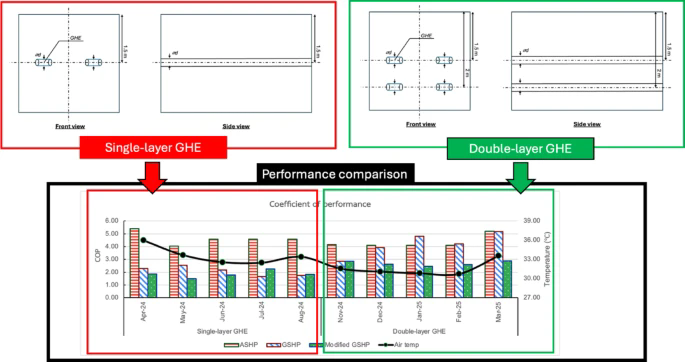
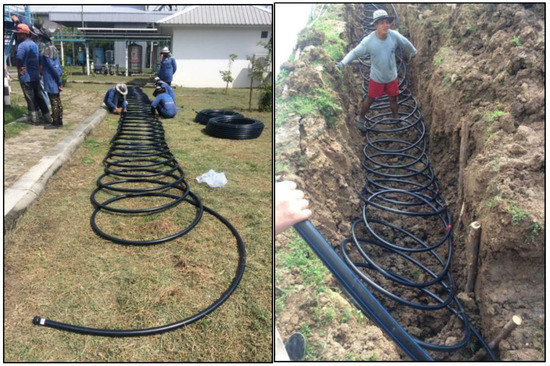
The research team conducted field experiments at Chulalongkorn University's Saraburi campus, comparing three systems: a conventional air source heat pump (ASHP), a conventional GSHP, and a modified GSHP with an optimized horizontal ground heat exchanger (HGHE) layout.
The Numbers: 49% Electricity Reduction
The results are striking:
| System | Electricity Savings vs. ASHP | COP Improvement |
| Conventional GSHP | ~40% less | — |
| Modified GSHP (single-layer) | ~49% less | — |
| Double-layer HGHE | 39% less vs. single-layer | 50% |
Chulalongkorn University study, Earth Systems and Environment 2026
The double-layer horizontal ground heat exchanger configuration — which uses less land area than a conventional single-layer layout — proved particularly effective. It improved heat exchange efficiency, resulting in a 39% reduction in energy consumption and a 50% increase in COP compared to the single-layer configuration.
A previous study from the same research group found that GSHPs with horizontal heat exchangers consumed 17.1% to 18.4% less electricity than conventional air conditioners during a two-month operation period . The more recent 2026 study shows that with optimized HGHE design, savings can reach as high as 49%.
Environmental Impact: Up to 71% CO₂ Reduction
Beyond energy savings, the study conducted a Life Cycle Assessment (LCA) to quantify environmental benefits.
Key finding: The modified GSHP with a single-layer HGHE configuration achieved the lowest global warming potential, reducing CO₂ emissions by up to 71% per unit of delivered cooling energy.
This is a significant figure for buyers evaluating the environmental credentials of HVAC systems. For a region where cooling demand is year-round and growing, the emissions reduction potential of GSHPs is substantial.
The research also found that intermittent operation — typical in real-world applications — allows the ground sufficient time to dissipate heat, preventing significant subsurface temperature rise. This addresses a concern about long-term thermal imbalance in cooling-only GSHP applications.
Why This Research Matters for the Southeast Asian Market
1. It proves GSHPs work in the tropics
The Chulalongkorn research provides rigorous, peer-reviewed evidence that GSHPs are not limited to cold or temperate climates. This is important for buyers in Thailand, Vietnam, Indonesia, and other Southeast Asian markets who may have been skeptical of GSHP viability.
2. Local research = local credibility
Having a Thai university conducting and publishing this research adds credibility. It shows that the technology has been tested under actual Thai conditions — not just simulated or imported from European studies.
3. It addresses the "land constraint" problem
In densely populated Southeast Asian cities, land is limited. The double-layer HGHE configuration demonstrated in this research requires less land area than conventional horizontal GSHPs while delivering better performance. This is a practical solution for urban applications.
4. It aligns with regional decarbonization goals
Southeast Asia's cooling demand is growing rapidly. The ASEAN energy ministers have already passed a joint declaration on heating energy efficiency transition. GSHPs, with up to 71% CO₂ reduction potential, are a proven solution.
What This Means for Buyers
If you are evaluating GSHPs for tropical climates:
| Consideration | Implication |
| 49% energy savings | Significant operational cost reduction |
| Up to 71% CO₂ reduction | Strong ESG credentials |
| Double-layer HGHE design | Land-efficient, suitable for urban sites |
| Peer-reviewed Thai research | Validated for local conditions |
Questions to ask suppliers:
What is the COP under tropical conditions? — Look for performance data specific to your climate
What is the recommended HGHE configuration? — Ask about double-layer or other space-saving designs
Is a Life Cycle Assessment available? — Check environmental credentials