
Executive Summary: Two Reports, One Contradiction
In May 2026, two major reports were released that together define the current state of the global heat pump industry.
The International Energy Agency (IEA) published Energy Technology Perspectives 2026, identifying heat pumps as a core technology for the electrification era — but warning of serious supply chain vulnerabilities, particularly around compressors.
At almost the same time, the European Heat Pump Association (EHPA) released Q1 sales data showing that the European heat pump market is experiencing a strong upswing: 17% year-over-year growth, with Germany posting a remarkable 34% jump.
One warning, one celebration. Taken together, these two reports pose a critical question for heat pump buyers, manufacturers, and investors: How do we manage deep supply chain risks while riding a wave of rapid market growth?
The Good News: European Market Momentum
The Headline Numbers
According to EHPA data, 11 European countries sold a total of 575,151 residential heat pumps in Q1 2026 — a 17% increase from 493,556 units in Q1 2025.
This growth is particularly notable because it happened while the European economy remained under pressure from energy price volatility. Paul Kenny, Director General of EHPA, put it bluntly:
"If your streaming service doubled its price then blocked its movies, you'd find a better one. Consumers have realised heat pumps are the solution when gas and oil are erratic in price and supply."
Country-by-Country Performance
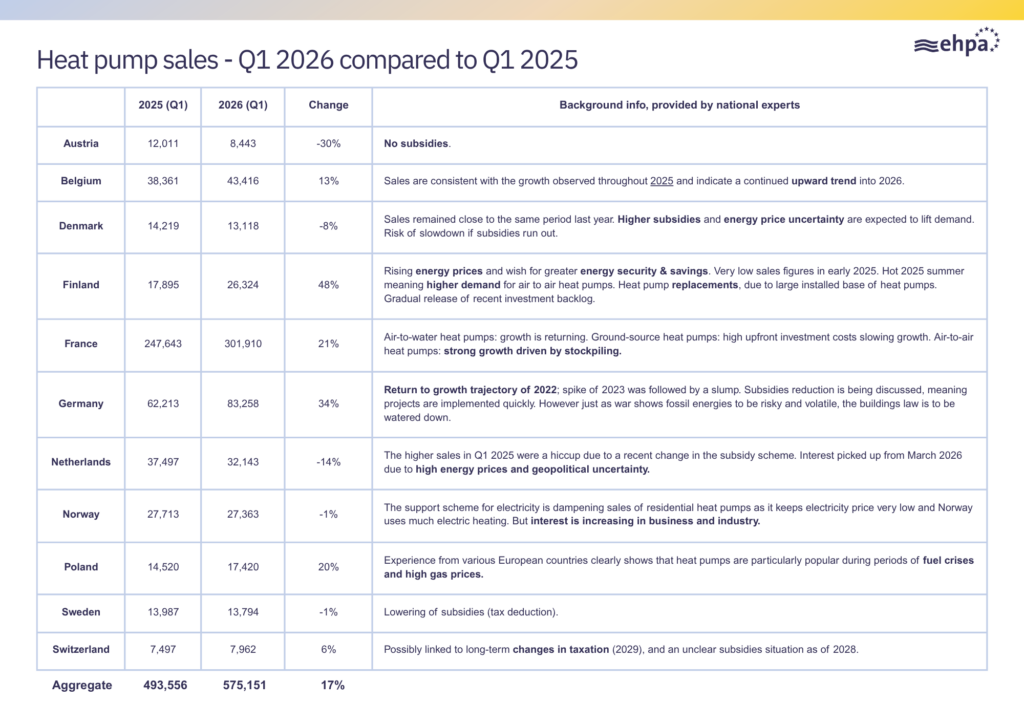
Three key takeaways from this table:
Germany is the engine of this growth. A 34% increase signals a return to the rapid expansion path of 2022. Ongoing discussions about new subsidy schemes have actually prompted some consumers to purchase earlier rather than wait.
France remains Europe's largest single market. 300,000 units in a single quarter is unmatched by any other country. However, the 21% growth rate is slightly below expectations — partly because some consumers are waiting for R290 models to become available.
Austria is a cautionary tale. The only country with a sharp sales decline. The reason? The government ended its heat pump subsidy program. This demonstrates that policy remains the single most important variable in heat pump markets.
The Immediate Driver: The Energy Crisis
EHPA points to a specific trigger for this growth wave: the Strait of Hormuz closure on March 2, 2026. This event caused natural gas prices to spike sharply, giving European consumers a direct experience of fossil fuel supply and price risks.
Kenny's full statement is worth quoting:
"Consumers have not been asked to buy heat pumps. They are buying them. The message here is very clear: They are not waiting. They want policymakers to keep up with them."
This points to a fundamental shift: heat pumps are moving from being a "policy-driven choice" to a "consumer-driven choice." For manufacturers and exporters, this is a structural tailwind — demand is becoming more endogenous and more stable.
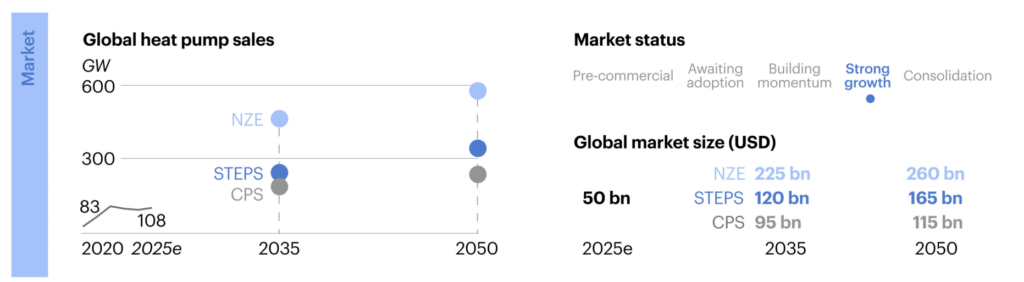
Extract from the ETP 2026 report’s “heat pump dashboard”, page 130. (NZE = net zero emissions by 2050, STEPS = stated policies, CPS = current policies scenarios).
The Warning: IEA's Supply Chain Risk
The IEA report opens with a striking macro figure: the global clean energy technology market reached $1.2 trillion in 2025. Over the past decade, this market has grown at 20% annually. By 2035, under stated policies, it is projected to reach $3 trillion. Heat pumps are listed as a "mature, scalable technology with massive system impact." In the IEA's energy transition modeling, heat pumps are not a supporting role — they are a core pillar.
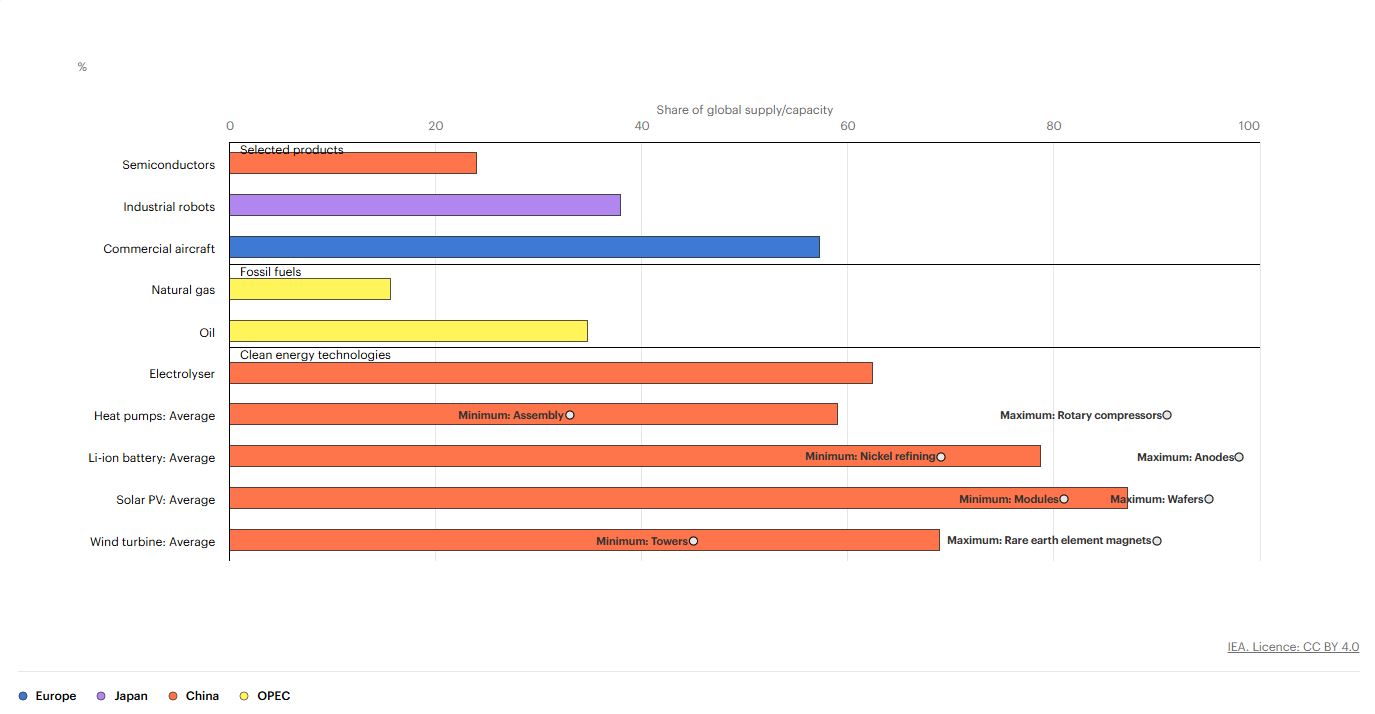
However, the report warns of extreme production concentration in China.
The Critical Numbers for Heat Pumps
· 90% of the world's rotary compressors are made in China.
· Compressors account for up to one-third of a heat pump's total cost.
This creates a single point of failure. As the IEA states, "a supply chain is only as secure as its weakest link."
The 'N-1' Stress Test
To quantify the risk, the IEA estimated that a one-month halt in battery exports from China would cost overseas EV plants $17 billion. The logic is the same for heat pump compressors. A sudden stop would cripple European production within weeks.
The Manufacturing Cost Gap
Why can't production just move to Europe? The answer is cost.
The IEA reports that European manufacturing costs for air-to-water heat pumps are approximately 60% higher than in China.
These gaps are driven by automation, energy, and labor costs. "These are not gaps that can be closed by tariffs alone," the IEA concludes.
What This Means for Buyers
Based on these reports, here are four strategic takeaways for heat pump buyers:
· Plan for compressor volatility. Diversify your supplier base and build longer lead times into your contracts.
· Re-evaluate 'local' sourcing. European-made units cost 60% more but offer supply security. Calculate total landed cost, not just unit price.
· Expect continued demand growth. The long-term trend remains strong. The global clean tech market is set to nearly triple by 2035.
· Watch policy closely. Austria's 30% sales drop is a warning. Do not over-rely on any single national market.
Conclusion
May 2026 presents a clear picture: European consumer demand is surging, but the industry's supply chain has a critical weak point.
Heat pumps are no longer a niche technology. The IEA calls them a "core pillar" of the energy transition. For industry players, the strategy is dual: aggressively pursue the growing market while actively managing supply chain risks.