
Germany is Europe’s Largest Heat Pump Market — and the Most Heavily Subsidized
Germany remains the single largest heat pump market in Europe. After a difficult 2024 that saw sales fall by nearly half, the market has rebounded strongly — posting 34% growth in Q1 2026.
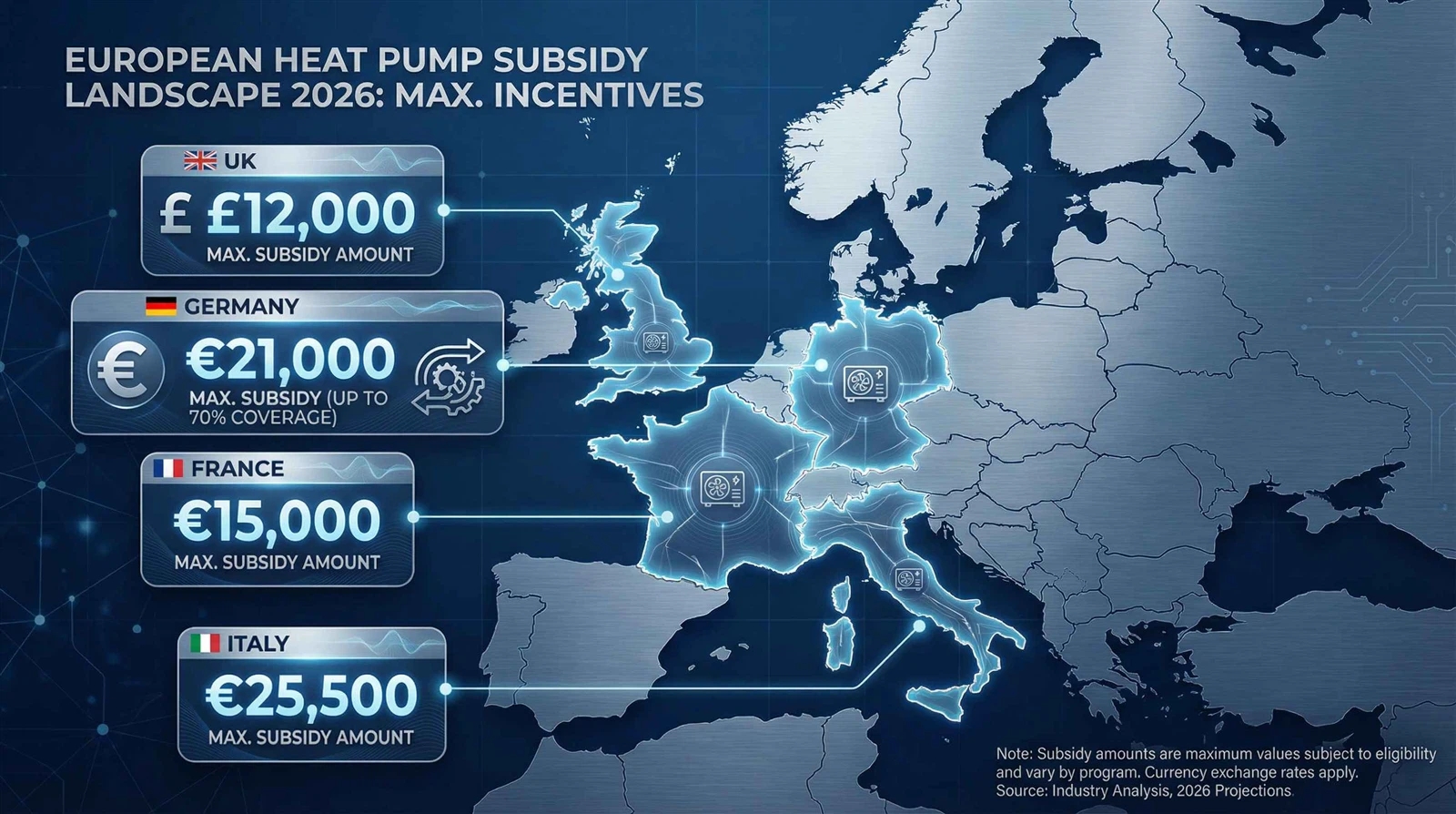
At the center of this recovery is a generous federal subsidy program that covers 30% to 70% of installation costs, with a maximum payout of up to €21,000 per residential unit.
For European buyers, importers, and distributors, understanding how this subsidy works is essential. It directly affects consumer purchasing decisions, project payback periods, and ultimately — demand for heat pump products.
This article breaks down the key elements of Germany’s 2026 heat pump subsidy framework, recent policy changes, and what it means for exporters.
The 2026 Subsidy Framework: How Much and Who Qualifies
2.1 Subsidy Rates
German homeowners can receive subsidies covering 30% to 70% of eligible installation costs. The final percentage depends on three factors:
| Subsidy Component | Rate | Condition |
| Base subsidy | 30% | Any qualifying heat pump installation |
| Efficiency bonus | 20% | Installing a particularly efficient heat pump (e.g., using natural refrigerants like propane/R290) |
| Low-income bonus | 20% | Households with taxable annual income below €40,000 |
| Maximum total | 70% | Combining all applicable bonuses |
2.2 Maximum Payouts
Single-family homes: Up to €5,000 in direct funding, plus a KfW loan of up to €120,000 per residential unit with reduced interest rates.
Multi-family homes: Up to €2,000 per unit, capped at €20,000.
Commercial/industrial units (20-50kW): Up to €21,000 per unit.
2.3 Eligibility Requirements
To qualify for BAFA (Federal Office for Economic Affairs and Export Control) subsidies, heat pumps must:
Be listed on BAFA’s official list of tested heat pumps — verified by an independent institute.
Meet minimum efficiency standards — A++ or A+++ energy efficiency class in heating mode.
Be installed by a certified specialist company — self-installation does not qualify.
Use the system for at least 10 years — otherwise, subsidies may need to be repaid.
Major Policy Shift: The 65% Renewable Mandate Has Been Abolished
3.1 What Changed
In February 2026, Germany’s coalition government passed a draft law repealing the controversial 2023 mandate that required new heating systems to run on 65% renewable energy.
The new approach is technology-neutral — homeowners can now choose:
Heat pumps (renewable)
District heating connections
Gas or oil boilers using green gases (biomethane) or green oils (e-fuels), subject to quota requirements.
Green gas/oil quotas will start at 10% in 2029 and gradually increase to support fossil-based systems in transitioning to lower-carbon fuels.
3.2 Why This Matters for Heat Pump Suppliers
Positive side: Subsidies remain in place until at least 2029. The €800 million annual budget for climate-friendly heating was confirmed in the 2026 federal budget.
Cautionary side: Some utilities are now calling to end heat pump subsidies in areas where district heating networks are being expanded, arguing that double subsidies create unfair competition.
For exporters, this means:
The market remains strong — subsidies are not going away soon
Targeted marketing matters — focus on areas without planned district heating expansion
Premium positioning — homes choosing gas/oil will face rising fuel costs; pitch your heat pumps as the long-term economic choice
"Bottom line from Allianz Trade: Even after subsidies, out-of-pocket costs often exceed €9,000–12,000, recouping the difference can take more than seven years — but for homeowners planning to stay long-term, heat pumps are still the winning bet."
The Controversy: District Heating vs. Heat Pumps
4.1 The Utility Argument
Germany’s municipal utilities (VKU) are investing billions in expanding district heating networks. Their concern: homeowners will buy heat pumps before pipelines reach their streets, leaving utilities with stranded investments.
Ingbert Liebing, head of VKU, told Welt am Sonntag:
"Double subsidies for heating networks and heat pumps are not a good idea. Where the district heating expansion area has been determined, subsidies for heat pumps should therefore be discontinued."
4.2 The Counter-Argument
City officials push back, noting that even when areas are designated for district heating expansion, homeowners are not obligated to connect. Forcing homeowners to wait for district heating could delay decarbonization.
4.3 What Exporters Should Watch
As of June 2026, no final decision has been made. Cities with more than 100,000 inhabitants must submit final district heating expansion plans by the end of June 2026.
Short-term implication: Subsidies remain fully available everywhere.
Medium-term risk: Some areas may lose heat pump subsidy eligibility once district heating expansion plans are finalized.
Advice: Encourage German buyers to apply early while subsidies are universally available.
What This Means for Heat Pump Exporters
5.1 The German Market Opportunity
| Factor | Implication |
| 34% Q1 2026 sales growth | Market recovery is real and accelerating |
| €800 million annual subsidy budget | Government committed to funding |
| Up to 70% coverage | Extremely attractive to homeowners |
| 7+ year payback still cited | But falling as gas prices rise |
5.2 Required Certifications for BAFA Eligibility
To access German subsidies, heat pumps must appear on BAFA’s approved list. This typically requires:
TÜV certification (technical safety inspection)
Independent performance testing
Listing on BAFA’s official heat pump register
5.3 Strategic Recommendations
For European distributors:
Prioritize BAFA/TÜV-certified products — without these, your customers cannot claim subsidies
Focus on efficiency bonuses — units using natural refrigerants (R290) qualify for the +20% efficiency bonus
Target regions without planned district heating — these areas face no subsidy uncertainty
Educate buyers on total cost of ownership — gas may seem cheaper upfront, but rising CO₂ prices will flip the equation
For manufacturers outside Germany:
Get BAFA-listed — this is the gateway to the German market
Highlight R290 compatibility — efficiency bonuses favor natural refrigerants
Work with local installers — subsidies require professional installation; having a certified partner network is essential