



The Installer Bottleneck: A Persistent Industry Problem
For years, the UK heat pump market has faced a well-documented challenge: not enough qualified installers.
Government targets call for 5 million home upgrades by 2030 under the Warm Homes Plan — a pace requiring roughly 24,000 installations per week. Yet MCS-certified heat pump installation companies number in the low thousands, not the tens of thousands needed.
As the Heat Pump Association has consistently flagged, the engineer pipeline is the binding constraint. Apprenticeships take 2-3 years to produce fully qualified installers. Even cross-training experienced gas engineers requires significant time and investment.
This context makes the latest government research particularly significant.
The Numbers: 94% Satisfaction, 11,300+ Courses Funded
On June 4, 2026, the UK Department for Energy Security and Net Zero (DESNZ) published the mid-scheme review of its Heat Training Grant programme.
The results are striking:
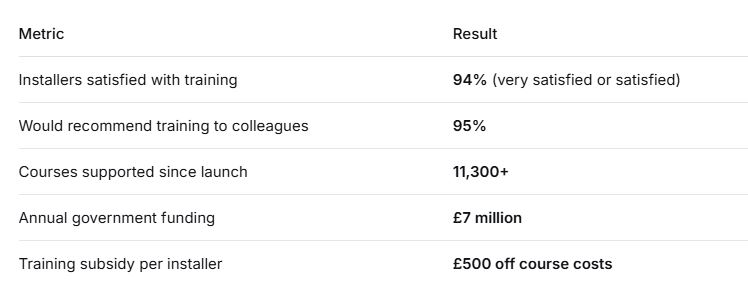
The grant, first launched in July 2023, offers up to £500 off the cost of approved heat pump installation courses — often making them low-cost or entirely free for experienced heating engineers.

Why This Matters: From Training to Actual Installations
High satisfaction scores are encouraging. But the real question is: Are these trained installers actually installing heat pumps?
Historically, there has been a significant gap. A study by the Heat Pump Association found that 73% of trained heat pump installers do not carry out an installation within the first 12 months of passing their training.
To address this, initiatives like the "Start at Home" scheme — launched by Renewables Centre in partnership with Nesta — offer newly trained installers a free heat pump for their own home, along with MCS designs and commissioning support. This low-risk environment helps bridge the gap between certification and real-world practice.
The Heat Training Grant itself is also evolving. The Warm Homes Plan has pledged £7 million per year for the grant through 2029, supporting the creation of 180,000 additional jobs in energy efficiency and clean heating by 2030.
Daikin's Role: 3,000 Installers Trained in One Year
To mark the research publication, Energy Consumers Minister Martin McCluskey visited Daikin's state-of-the-art training academy in Manchester — meeting some of the 3,000 installers who have trained with Daikin this year alone.
Minister McCluskey commented:
"The trainees and instructors here, and across the country, are on the frontline of getting Britain off the fossil fuel rollercoaster. With over 11,300 heat pump training courses already delivered, research today shows the scheme has been massively popular with those taking it on."
Daniel Jackson, Training Manager at Daikin UK, added:
"The Heat Training Grant is playing an important role in accelerating the upskilling of the heating workforce. At Daikin, we've already helped hundreds of installers access grant-funded training and are seeing growing interest from engineers looking to diversify into low-carbon technologies."
Daikin's training is delivered free of charge to engineers — removing financial barriers as part of a broader effort to transition the workforce from fossil fuel systems to low-carbon technologies ahead of the UK's 2030 decarbonisation targets.

What This Means for Exporters
For heat pump manufacturers and exporters supplying the UK market, this news carries several implications:
| Factor | Implication |
| Growing installer confidence | 94% satisfaction suggests better-trained, more reliable installation outcomes — reducing product-related complaints and warranty claims |
| Expanding workforce | 11,300+ courses funded means more installers entering the market, increasing total addressable installation capacity |
| Long-term funding commitment | £7 million annually through 2029 provides policy certainty for market planning |
| Still a constraint | Despite progress, the UK remains far from the 180,000-job target. The installer shortage is easing, but not yet solved |
For now, exporters should be aware that installation capacity remains a limiting factor. Partnering with training academies or offering installer support programmes could become a competitive advantage in the UK market.