
The Big Picture: A Decade of Growth
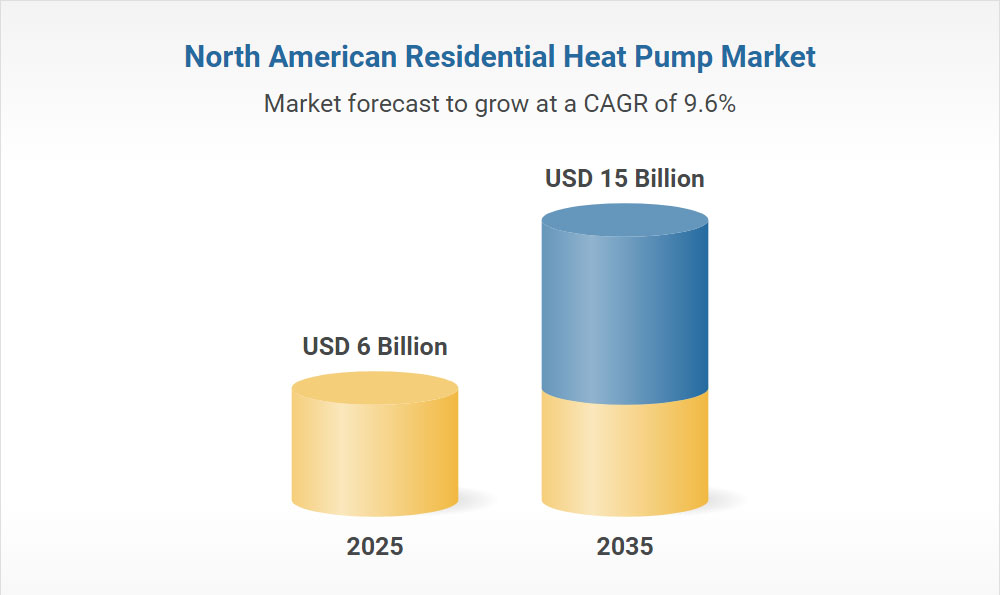
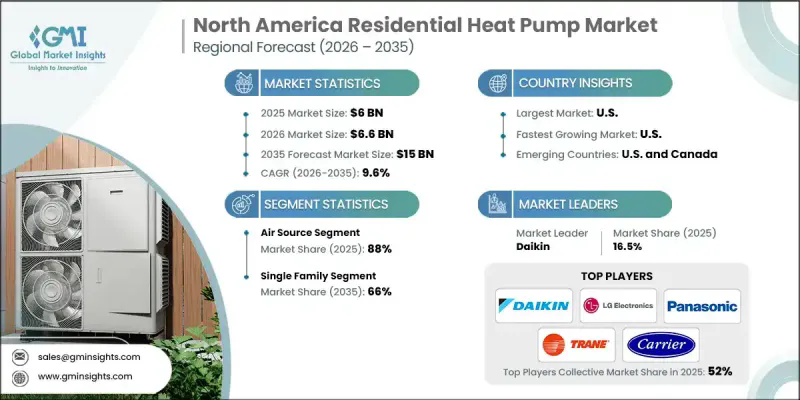
The North American residential heat pump market is entering a period of rapid expansion. According to a newly released report by Global Market Insights Inc., the market is set to reach 66 billion in 2026, up from 60 billion in 2025.
By 2035, the market is projected to grow to $150 billion, representing a compound annual growth rate (CAGR) of 9.6% from 2026 to 2035. This is not a short-term spike — it is a structural shift in how North Americans heat and cool their homes.
What is driving this growth?
Several long-term trends are converging:
Rising consumer demand for energy-efficient heating and cooling solutions. Homeowners increasingly recognize both the environmental and financial benefits of heat pump technology.
Supportive government initiatives at federal, state, and local levels, including tax credits, rebates, and grant programs that reduce upfront installation costs.
Regulatory efforts phasing out traditional furnaces and boilers. Several states have passed legislation limiting fossil fuel-based heating systems in new construction.
Growth in residential construction and retrofitting projects. The post-pandemic housing boom, combined with aging housing stock, has created robust demand for both new installations and replacements.
Technological advances, including smart controls, AI integration, and improved cold-climate performance. Modern heat pumps are quieter, more efficient, and more reliable than units from just five years ago.
The United States: The Dominant Market
The United States accounts for the vast majority of the North American market. In 2025, the U.S. alone held 96.1% of market value, generating $58 billion.
Why is the U.S. market growing so fast?
Policy and incentives
· Federal tax credits for ENERGY STAR Most Efficient heat pumps provide up to $2,000 per year for qualifying installations under the Inflation Reduction Act.
· State-level initiatives include the $450 million Heat Pump Accelerator program launched by five New England states (Connecticut, Maine, Massachusetts, New Hampshire, Rhode Island) in November 2025.
· Multistate commitments: Nine states — California, Maine, Colorado, Maryland, New Jersey, Massachusetts, New York, Rhode Island, and Oregon — have committed to 65% heat pump penetration by 2030 and 90% by 2040.
New construction trends
According to the U.S. Census Bureau's 2024 Survey of Construction, nearly all new single-family homes built in 2024 featured heat pumps as the primary heating solution. Heat pumps accounted for 82% of heating systems in the South Atlantic states and 77% in the East South Central states.
Retrofit and replacement demand
The average furnace or boiler in the U.S. is 15-20 years old, and millions of units are reaching end of life. Homeowners facing replacement decisions are increasingly choosing heat pumps over traditional systems. Improved cold-climate technology has made heat pumps viable even in the Northeast and Midwest.
Air Source Heat Pumps Lead the Way
Within the residential market, air source heat pumps are the clear technology leader. In 2025, air source units held 88.5% market share, far outpacing ground source and water source systems.
Why do air source heat pumps dominate?
· Dual functionality — they provide both heating and cooling, as well as domestic hot water in some configurations. This "all-in-one" capability is highly attractive to homeowners.
· Easy installation compared to ground source systems, which require excavation or drilling for ground loops costing 10,000−20,000 or more.
· Improved cold-climate performance — modern units operate reliably at temperatures as low as -25°C and below. Inverter-driven compressors and EVI technology have eliminated the cold-weather penalty of earlier generations.
· Lower upfront cost — 4,000 to 8,000 installed, compared to 15,000 - 25,000 for ground source systems.
Application segments
Single-family homes account for 66% of the residential market, projected to grow at a CAGR of 9.5% through 2035. Multi-family homes make up the remaining 34%.
What This Means for Heat Pump Exporters
The North American market is large, growing, and not yet saturated. Key established players include Daikin, Carrier, Bosch, Trane, Samsung, LG, Midea, and Lennox. But the 9.6% CAGR means there is room for new suppliers offering competitive pricing, reliable performance, and proper certifications.
For exporters targeting North America:
Certifications matter
Entering the U.S. market requires:
· AHRI certification — industry standard for performance verification
· ENERGY STAR compliance — required for federal tax credits
· UL listing — safety and electrical compliance
· DOE compliance — legal minimum efficiency standards
Cold-climate performance is a selling point
Units rated for operation down to -25°C or lower have a competitive advantage in northern states. Several states including Maine, New York, and Vermont offer incentive programs specifically favoring cold-climate certified units.
Canada is the fastest-growing market
While the U.S. dominates by size, Canada is the fastest-growing country in the region. Exporters should not overlook Canada, where government incentives and cold-climate demand are driving adoption.
The bottom line
The North American residential heat pump market is on a clear growth trajectory — from 60 billion in 2025 to 66 billion in 2026 and $150 billion by 2035. For heat pump manufacturers and exporters, North America represents a strategic opportunity. The question is not whether to enter — but when.